When Faith Breaks the Rules

Mark 5:21–43 — When Faith Breaks the Rules
We started the night with a game of Wavelength, which is always a good reminder that sometimes the hardest thing to do is land in the middle of what everyone else thinks. That led to a simple but uncomfortable question. When have you gone against popular opinion to do what you knew was right? Not what was safe. Not what was expected. Just what was right.
That question sits right at the heart of Mark 5.
When Jesus crosses back over the sea, He is immediately surrounded by a crowd. Then Jairus shows up. Mark tells us he is one of the rulers of the synagogue. That detail matters. Jairus is not a nobody. He has a title, a reputation, and a lot to lose. And yet when his daughter is dying, he throws dignity out the window and falls at Jesus’ feet.
What does Jairus risk by approaching Jesus? His credibility. His standing. His job. His relationships. Associating with Jesus at this point is not a neutral move.
But what does he risk by not approaching Jesus? His daughter’s life.
That choice is already heavy, and then Mark does something frustrating. He interrupts the story.
A woman who has been bleeding for twelve years pushes her way through the crowd. Twelve years is not a throwaway detail. That is over a decade of constant suffering. Practically speaking, this would have been exhausting and isolating. Chronic blood loss means weakness and likely anemia. Daily life would have been incredibly difficult.
Culturally and religiously, it is even worse. Under Jewish law, her condition made her ceremonially unclean. That meant separation from people and separation from worship. She is not just sick. She is cut off. From community. From the temple. From God, as far as the system is concerned.
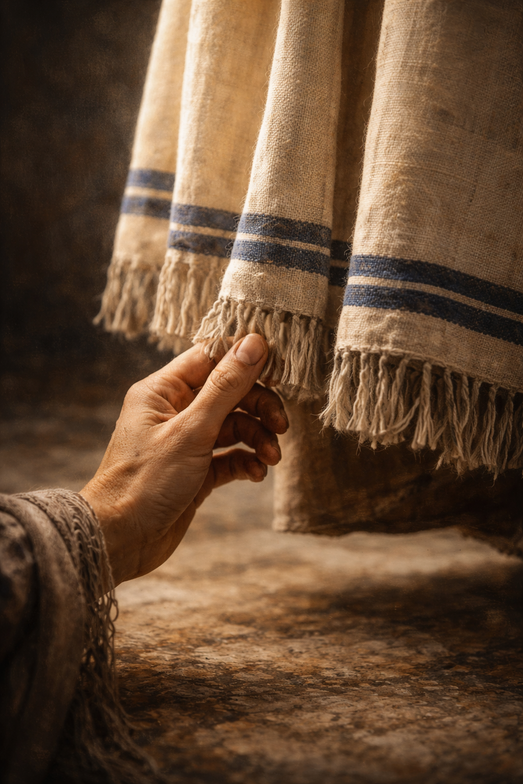
She has spent all her money on doctors and only gotten worse. So she does the one thing left. She reaches out and touches the edge of Jesus’ garment, thinking, If I can just touch Him, I will be healed.
This is where Malachi quietly steps into the story. Malachi speaks of the “sun of righteousness” rising with healing in its wings. The Hebrew word for wings, kanaph, also means the edge or fringe of a garment. Jewish men wore fringes as a reminder of God’s law. The image is layered. Healing rays of the sun. The hem of a garment. God’s power meeting human need.
And it works.
Jesus feels power leave Him. That alone is worth sitting with. Jesus is fully human, and yet fully carrying the power of God. He stops. He asks who touched Him. The disciples think this is ridiculous. Of course someone touched Him. Everyone is touching Him.
But Jesus waits.
The woman comes forward in fear and trembling and tells the truth. And Jesus does not scold her. He does not correct her theology. He calls her “Daughter.” He restores her peace, her body, and her place.
Then we snap back to Jairus.
While Jesus is still speaking, people arrive with the news that Jairus’ daughter is dead. The implication is clear. You waited too long. Don’t bother Jesus anymore.
Jesus hears it and immediately says, “Do not fear, only believe.”
They go to the house. There is chaos and loud mourning. Jesus says the girl is not dead but sleeping, and they laugh at Him. He clears the room. He takes the parents and a few disciples inside. He takes her hand. He speaks gently. “Little girl, arise.”
And she does.
She is twelve years old. The woman suffered for twelve years. Mark wants us to notice that.
Jesus then does something wonderfully ordinary. He tells them to give her something to eat. Resurrection meets real life.
By the end of Mark 5, Jesus has healed a man with an unclean spirit, a woman made unclean by illness, and a girl made unclean by death itself. The common thread is not just healing. It is authority. In every case, Jesus comes into contact with what should make Him unclean, and instead, the unclean becomes clean.
That is the pattern of the kingdom of God. Jesus is not contaminated by brokenness. He overwhelms it.
Both Jairus and the woman have to step past fear, reputation, and social rules to reach Jesus. One approaches loudly and publicly. The other quietly and desperately. Jesus honors both.
Faith does not always look the same, but it almost always requires courage.

-
Our Saviour's Evangelical Lutheran Church