King Jesus Cleanses the Temple
Mark 11:12–19

Annie Pedersen
August 17, 2026
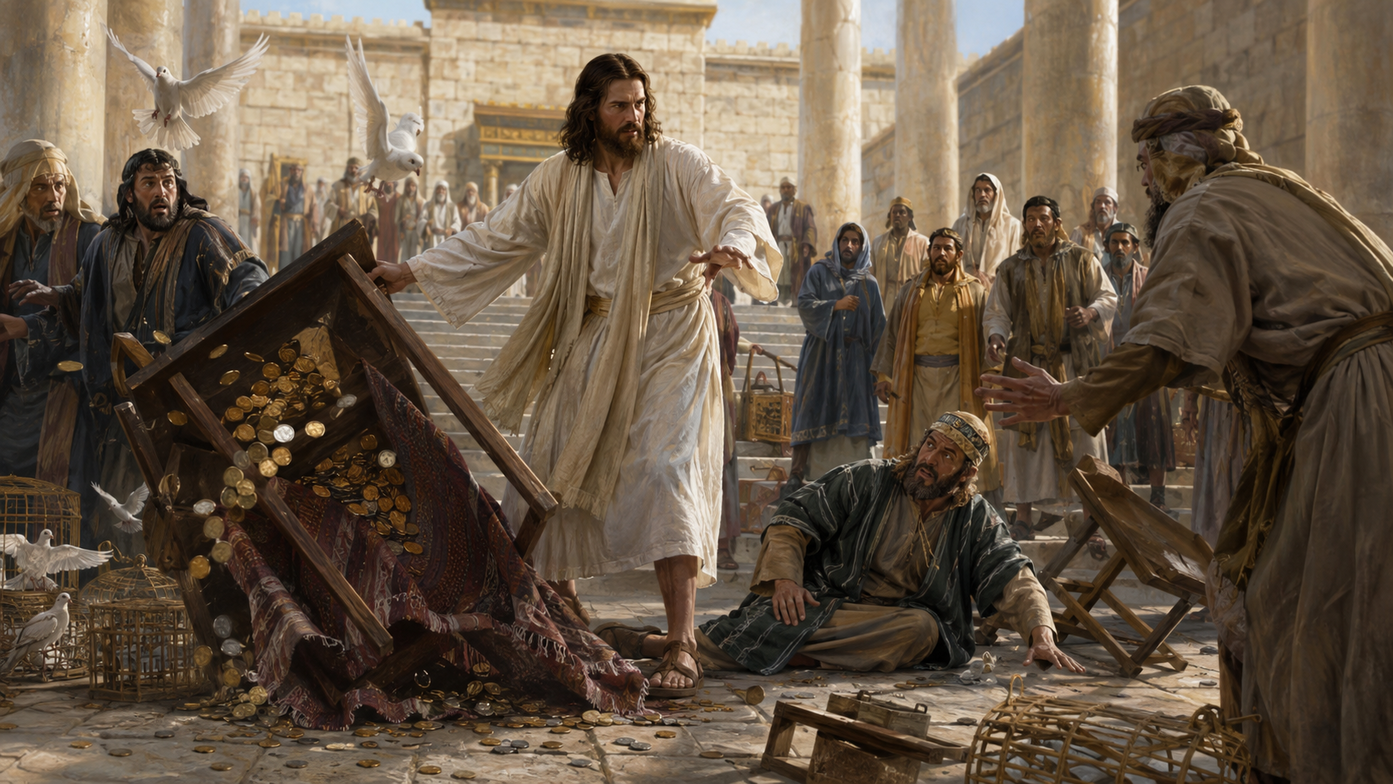
There are some things that everybody seems to accept as normal that, when you stop and think about them, are actually kind of ridiculous. Sometimes something has been done a certain way for so long that nobody really questions it anymore.
I think there is a little bit of that happening when Jesus enters the Temple in Mark 11.
We pick up right after Jesus rides into Jerusalem on a donkey, fulfilling Old Testament prophecy about the Messiah riding into the holy city of Jerusalem. There is a massive crowd and tons of fanfare. Among these are presumably plenty of people who are familiar with the Scripture from Zechariah 9:9:
“Rejoice greatly, O daughter of Zion!
Shout, O daughter of Jerusalem!
Behold, your King is coming to you;
He is just and having salvation,
Lowly and riding on a donkey,
A colt, the foal of a donkey.”
Jesus rides into Jerusalem and then goes to stay with His followers in Bethany, which is about two miles from Jerusalem. The next day He returns to Jerusalem.
Mark tells us that Jesus enters the Temple and begins driving out the people buying and selling there. He overturns the tables of the money changers and the chairs of those selling doves. He doesn’t allow anyone to carry merchandise through the Temple.
I have wondered a bit in the past when reading the story of Jesus cleansing the Temple why they didn’t arrest Jesus right then for creating a huge disturbance. It sounds destructive. It sounds like He made a huge mess. And this is happening at the beginning of Passover, when Jerusalem is packed with people.
But Jesus isn’t just throwing a fit. Mark tells us that He is teaching as He clears out the courtyard where animals are being sold for sacrifice and money changers sit, all likely at outrageous prices.
“My house will be called a house of prayer for all nations,” Jesus says, “but you have made it a den of thieves.”
Both parts of that sentence come straight out of the Old Testament.
The first comes from Isaiah 56. God is talking about foreigners who come to worship Him and says that He will bring them to His holy mountain and give them joy in His house of prayer.
“For my house will be called a house of prayer for all nations.”
God’s house was supposed to be a place where people from all nations could come to worship Him, but to understand the second half of Jesus’ statement, we need to go backward through some of Judah’s history and see what is happening in the Temple.
In 2 Kings 21, Manasseh becomes king of Judah and reigns for 55 years. The Bible tells us that “he did what was evil in the Lord’s sight, imitating the detestable practices of the nations that the Lord had dispossessed before the Israelites.”
Things get very dark. Manasseh rebuilds altars to false gods. He practices witchcraft and divination. He sacrifices his own son. And he even puts idols and altars to other gods and allows male prostitutes inside the Temple of the Lord. Of his reign, 2 Kings 21:16 says, "Manasseh shed so much inocent blood that he filled Jerusalem from end to end."
After Manasseh dies, his son Amon becomes king at age 22. Amon also does what is evil in the Lord’s sight, and he only reigns for two years before he is put to death by his own servants.
So Jerusalem has had a succession of very evil leaders who use the house of God to worship other gods. We’ve got witchcraft, divination, idolatry, prostitution and even the sacrifice of children happening in the house of God.
Then Josiah becomes king when he is 8 years old. By the time Josiah is 16, he begins seeking God. He starts purging Judah of the worship of other gods. Eventually, he orders that the Temple be repaired, and while they are repairing it, something incredible happens. They find "a book." And it's not just any book. It turns out to be the Book of the Law!
Think about what that means. They have gotten so far away from God’s Word that when it is rediscovered in the Temple, Josiah realizes how badly Judah has been disobeying God. He tears his clothes in grief.
Then Josiah gathers the people at the Temple and has the Book of the Law read aloud. He tears down the altars that had been built in the courtyards of the Temple. He removes the things that had been used to worship other gods. Josiah is, quite literally, cleansing the Temple.
Then he reinstitutes the Passover. And that detail brings us full circle back to Jesus in the Temple, because that is the very celebration that Jesus and His disciples in Jerusalem for in Mark 11. Passover.
Josiah was a good king who walked into a corrupted Temple and started cleaning it out. Now Jesus has ridden into Jerusalem and has been received by a huge crowds as a king. Again it is Passover. Jesus walks into the Temple and starts cleaning it out.
Josiah made huge reforms. The Temple was repaired, the Book of the Law was rediscovered, Idols were removed, and Passover was restored. But fixing the building and getting rid of the idols did not automatically change the hearts of the people. The prophet Jeremiah began his ministry during Josiah’s reign.
And in Jeremiah 7, God confronts the people of Judah because they are stealing, murdering, committing adultery, worshiping other gods, and then coming into the Temple and acting as though being there somehow makes them safe.
They are basically saying, "We have the Temple and our God so we are fine." Or as Pastor Tim likes to say, they are "checking off the right religious boxes." Jeremiah tells them otherwise.
“Has this house, which bears my name, become a den of robbers in your view?” Jeremiah 7:11. That phrase should sound familiar.
In Mark 11, Jesus walks into the Temple during Passover. He drives out the people buying and selling and overturns the tables of the money changers. Then He pulls together the words of Isaiah and Jeremiah, “My house will be called a house of prayer for all nations, but you have made it a den of thieves.”
There is one more piece of this that is easy to miss. The outer court of the Temple was the area where Gentiles could come to worship God. That was the area filled with buying, selling, noise, animals, money changers, and commerce. Think again about Isaiah’s words, “A house of prayer for all nations.”
What happens when the place set aside for the nations to worship God becomes filled with buying and selling instead? The problem wasn’t simply that people were conducting business near the Temple. The problem was what the Temple had become. The place where people were supposed to come near to God had been turned into something else.
I used to read this story mostly as Jesus getting angry and flipping tables. And He certainly was angry, but there is much more happening here.
There is a history of good kings cleansing the Temple, and the religious leaders know that history. Josiah entered a corrupted Temple and cleaned it out.
Jesus has just ridden into Jerusalem in a way that deliberately points back to the prophecy of a coming King. Then He enters the Temple during Passover and begins cleaning it out. Jesus isn’t only saying that something bad is happening in the Temple.
His actions are making a statement about who He is and what authority He has there. The King has arrived, and He has every right to clean His house.
Ministries
Youth Group

-
Our Saviour's Evangelical Lutheran Church
Contact
Menu
About
© 2026 Our Saviour's Evangelical Lutheran Church. All Rights Reserved.
|
Login
powered by
Website Developed by Tithely